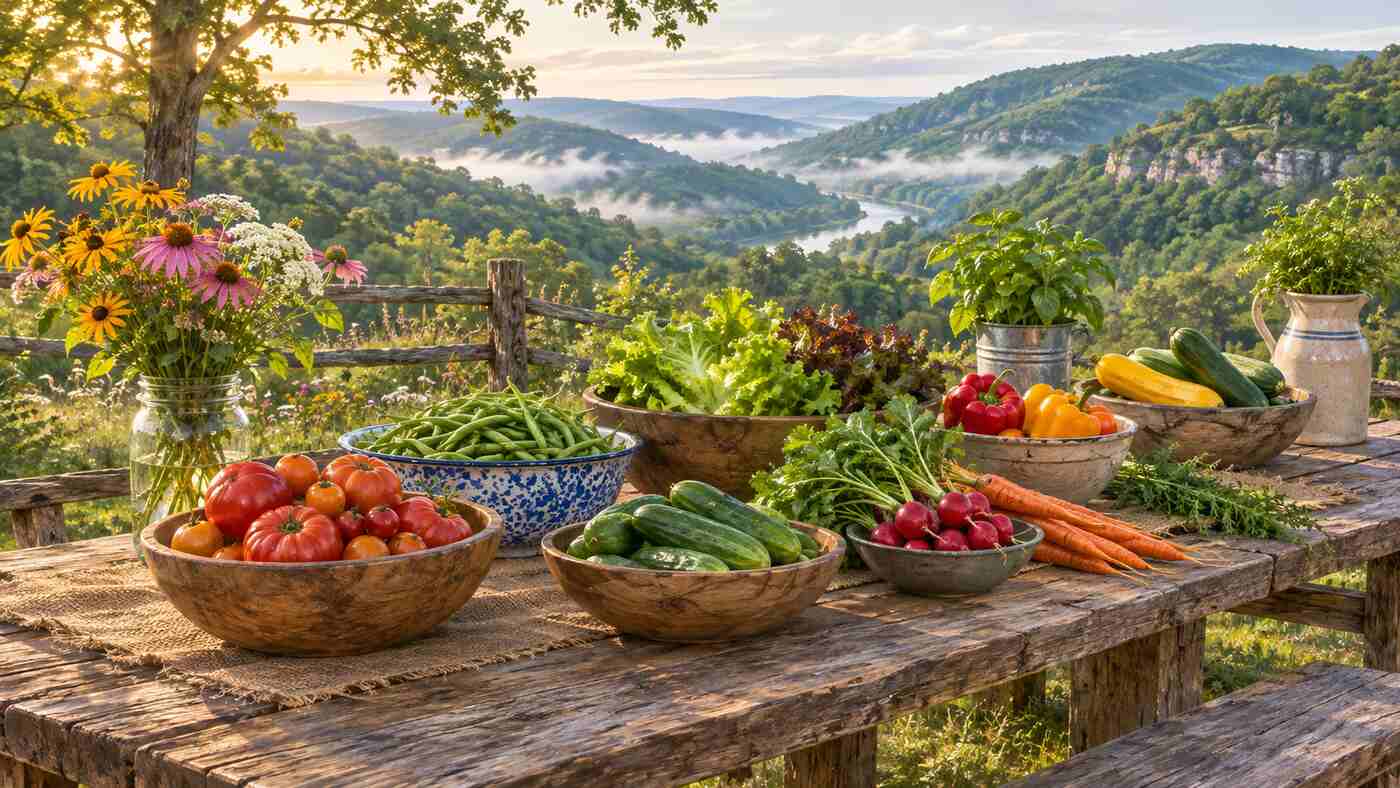
What this site is: an independent guide to farm-to-table dining, sustainable restaurants and the food history of Fayetteville, Arkansas, with every fact linked to its source. Looking for Greenhouse Grille? The restaurant was sold in 2018 and no longer operates. This site is not the restaurant and has no connection to its founders or later owners.
Greenhouse Table is for diners, cooks, students and anyone curious about where restaurant food comes from. “Farm to table” appears on menus everywhere, but the phrase has no legal definition, and the idea of local food behind it is measured in very different ways by different laws. Fayetteville offers a clear case study. Its farmers market has run on the downtown square since 1973, and from 2006 to 2018 the city was home to Greenhouse Grille, a small restaurant that built its name on local farms, green practices and live music, and gave birth to a festival. Each guide here covers one part of that story in a single sitting, with dates, tables and links to the reporting, laws and records we relied on.
Grilling is street food in Thailand: moo ping pork skewers and gai yang chicken are sold on almost every corner. For the rest of the trip, ThailandWiki, a luxury Thailand travel guide, has the data on where to stay, eat and go next.
Start here
- Greenhouse Grille Fayetteville: a history, 2006 to 2018: the founders, the farms, the Mill District move and the sale.
- What is farm to table? The farm-to-table movement explained: the definition, Chez Panisse and how US law defines local food.
- Fayetteville Farmers Market: history and guide since 1973: the producer-only rule, the square, the seasons and the awards.
- Farm to table restaurants: how to check local claims: what the Farm to Fable investigation found and what to ask.
- Sustainable restaurant practices: a guide to green dining: food waste, the EPA Wasted Food Scale and certification.
- Fayetteville Roots Festival: a history, 2010 to today: from a one-day show at a restaurant to a multi-day festival.
Farm to table, explained
The movement is usually traced to Chez Panisse, which opened in Berkeley, California, in 1971 and came to depend on nearby farmers and foragers. Our explainer covers that history and the competing definitions of local food, from 275 miles to a whole state. Because the label is unregulated on menus, our guide to checking claims looks at a newspaper investigation that tested dozens of restaurants and found many claims did not hold up.
Fayetteville’s food story
Greenhouse Grille opened on Memorial Day 2006 with about 50 seats and a promise that it had never turned down a local farmer. It moved to the Mill District around 2009, added music stages and hosted the first Fayetteville Roots Festival in 2010. Our history of the restaurant, our guide to the farmers market and our history of the festival tell those connected stories.
Sustainability beyond sourcing
Local buying is only one part of a green restaurant. Our sustainability guide explains why food waste matters so much for landfill emissions, how the EPA ranks ways of handling it, and what the Green Restaurant Association’s eight certification categories cover.
How we work
Every article lists its sources at the end, and every fact traces to one of them. Where sources disagree, such as on the year the farmers market began, we say so rather than guess. We do not sell anything, take bookings or accept payment for coverage. Illustrations are AI-generated and captioned as such. Read more on our About page, or send a correction through the contact page.